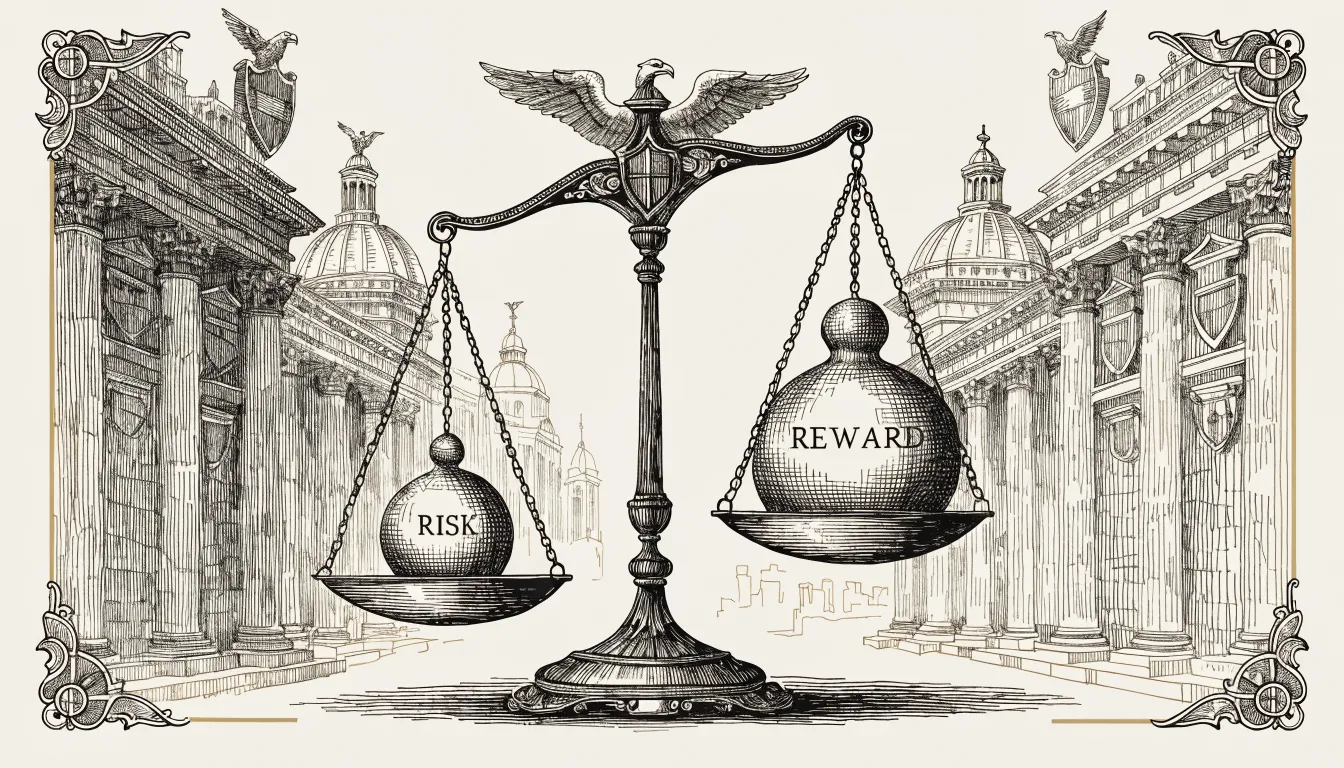
The Two Emotions That Run the Show
Fear and greed are not theories. They are the daily weather of the stock market. When greed is in charge, prices climb past any sensible valuation and people who should know better start saying “this time is different.” When fear takes over, solid companies get sold for less than the cash on their balance sheets and people who should know better start saying “the system is broken.” Neither statement is ever true. Both get repeated every cycle.
Warren Buffett’s line about being fearful when others are greedy and greedy when others are fearful is probably the most quoted sentence in investing. It is also one of the hardest to actually do. When your neighbour has doubled his money on a tech stock and won’t stop talking about it at the block party, your brain does not want to be cautious. It wants in. And when the market has dropped 30% and the headlines are screaming, your brain does not want to buy. It wants to hide. Doing the opposite of what you feel is the work.
How Greed Hurts Your Returns
Greed shows up in three ways that I’ve watched clients repeat for twenty years. They refuse to take profits when their target is hit. They add to winners until the position is too big to sleep on. And they chase stocks that have already run, buying in on the last third of the move.
A community member on our forum once wrote about a trade he’d just closed for a 25% gain in six days. That is a terrific result. Most years, most traders would take that number gladly. But he didn’t feel good about it. He felt regret, because if he’d held a little longer the gain would have been closer to 60%. He ended the post by admitting he wasn’t learning that lesson very well.
That post is honest and it’s universal. Greed reframes every win as a loss — not a loss against your entry price, but a loss against the best price you could have sold at in hindsight. Hindsight is a terrible benchmark. It is always available, it is always perfect, and it will always make you feel like you did something wrong.
The Antidote: Decide the Exit Before You Enter
The only reliable defence against greed is to decide how you’re getting out before you put a dollar in. Set a target price. Set a stop level or a trailing stop. Write it down next to the entry price. When the target hits, you sell. Not “I’ll see how it looks tomorrow.” You sell.
A sale at your pre-planned target is never a mistake, no matter what the stock does the next day. If it goes higher, that’s fine. It wasn’t your trade anymore. Boring is good. Discipline feels boring because it removes the story, and the story is where greed lives.
How Fear Hurts Your Returns
Fear is more dangerous than greed, and here’s the thing: greed makes you leave money on the table, but fear makes you lock in permanent losses. The technical term is panic selling. The practical term is turning a paper loss into a real one at the worst possible moment.
Our portfolio records from 2007–2008 show what that looks like in numbers. A position in UTVG.OB, entered at $5.65 in October 2007, was sold at $1.70 in December 2008 — a 69.9% loss. TBSI, bought at $53.58 in November 2007, was closed at $32.68 in March 2008 for a 39% loss. These weren’t poorly chosen companies. They were caught in a market-wide fear cascade, where every seller triggered more selling and nobody wanted to be the last one holding.
Financial news makes this worse on purpose. A 2% market decline becomes a banner headline with red arrows. The evening segment interviews someone predicting another 20% drop. None of that is news in any useful sense. It’s content designed to hold your attention through a commercial break, and it works on the same part of the brain that kept our ancestors alive by running from shadows.
The Antidote: Define Your Risk in Advance
You cannot eliminate fear. You wouldn’t want to — sometimes fear is correct, and sometimes selling really is the right move. What you can do is pre-define your risk. If you buy a stock at $10 with a stop at $8.50, you already know your maximum loss is 15%. You’ve accepted it before the trade began.
That acceptance is what prevents panic. Panic comes from not knowing how much you could lose. Once the answer is written on a piece of paper in front of you, there is nothing left to panic about. Either the stop hits and you take the planned loss, or it doesn’t and you hold. The decision was made weeks ago.
The VIX: A Thermometer for Fear
The CBOE Volatility Index, known as the VIX or “Fear Index,” measures what the options market is pricing in for the next 30 days of S&P 500 volatility. Below 15, markets are calm. Above 30, markets are frightened. During the 2008 crisis, the VIX hit 80, which implied traders expected the market to move 5% or more every single day.
A VIX above 30 is historically one of the better times to buy broad-market index funds. Data over the last several decades shows that buying the S&P 500 when the VIX spikes past 30 and holding for twelve months has produced positive returns most of the time. That doesn’t mean you nail the bottom — you usually won’t. It means you’re buying when everyone else is selling, which is where long-term returns come from.
The catch is that to do this, you have to buy when you are scared. That is the whole game.
Building the Discipline
Discipline is not a personality trait. It’s a set of habits, built the same way you build any habit: slowly, with structure, and with tolerance for the days you fall short. Here are the five habits I recommend to every client who asks me about trading:
- Write a trading plan. Entry rules, exit rules, position size, maximum loss per trade, maximum loss per week. If it isn’t written down, it doesn’t exist when you need it.
- Keep a trade journal. Record what you bought, why you bought it, what happened, and how you felt during the trade. The emotional notes matter as much as the numbers. Over time, patterns show up.
- Cap your position size. Never more than 5 to 10% of your portfolio in one stock. If no single trade can ruin your year, no single trade can make you panic.
- Take a cooling-off period after a big loss. At least 24 hours. The urge to win it back immediately is revenge trading, and it almost always makes things worse.
- Judge yourself on process. A good trade is one that followed your plan, whether or not it made money. A bad trade is one that broke your rules, even if it happened to be profitable.
The Emotional Cycle of the Market
Markets move through a fairly predictable emotional cycle: optimism, excitement, euphoria, anxiety, denial, fear, desperation, panic, capitulation, depression, hope, relief — and then back to optimism. Every bubble and every crash follows roughly this sequence. The only thing that changes is how fast it moves.
Traders who can locate themselves on this cycle tend to do better than traders who simply react. If you notice that your own feelings about the market have swung to euphoria, that’s a reason to check your exposure. If you notice you’re genuinely afraid to open your statement, that’s often a reason to keep buying on the schedule you already had. Your emotions, treated as a contrarian indicator, are surprisingly useful data.
This takes practice. Most people spend years reacting before they learn to notice. That’s normal. Don’t worry about it — just start keeping the journal, and the patterns will teach you what you need to know.
This week, if you don’t already have a written exit rule for your open positions, write one. One sentence per position is enough. It takes fifteen minutes, and it will save you more money over your lifetime than almost anything else you could do with that quarter hour.
See also: Position Sizing and Risk Management · The 2008 Financial Crisis · Support and Resistance · The Dot-Com Bubble · Value Investing