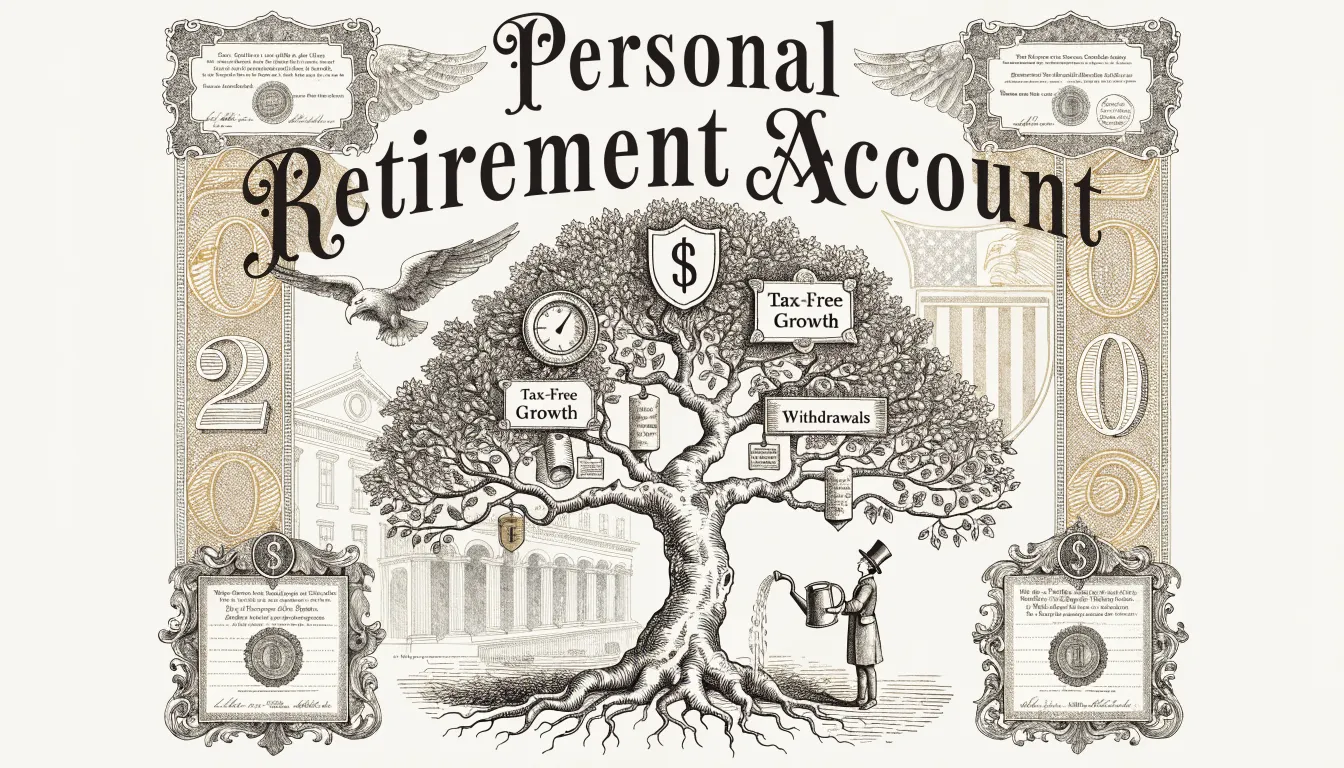
How a 401(k) Works
- You pick a contribution percentage. Usually 1 to 15 percent of your gross salary. The money comes out of your paycheck before federal and state income taxes are calculated, so your taxable income drops by the same amount you save.
- Your employer may match part of it. A common formula is 50 cents per dollar up to 6 percent of salary. On a $60,000 salary, contributing 6 percent ($3,600) earns you another $1,800 from the employer. That is a 50 percent return on day one, and you will not find that anywhere else.
- You choose how the money is invested. Most plans give you a menu of mutual funds: stock index funds, bond funds, target-date funds, sometimes company stock. You decide how to split the contributions across them.
- The money grows tax-deferred. Dividends, interest, and capital gains inside the account are not taxed each year. Compounding runs on the full balance, with no annual tax drag eating into it.
- You withdraw in retirement. After age 59½, withdrawals from a traditional 401(k) are taxed as ordinary income. Take money out before 59½ and you will owe regular income tax plus a 10 percent early-withdrawal penalty, with a few narrow exceptions.
Contribution Limits (2006)
| Category | Annual Limit | Notes |
|---|---|---|
| Employee contribution | $15,000 | Pre-tax or Roth (see below) |
| Catch-up (age 50+) | Additional $5,000 | Total: $20,000 for workers 50+ |
| Total (employee + employer) | $44,000 | Includes employer match and profit sharing |
These caps are adjusted for inflation every so often. The number that matters for most workers is the employee limit — $15,000 in 2006. Hitting the cap builds retirement wealth fastest, but the difference between contributing something and contributing nothing is a much bigger gap than the difference between contributing some and contributing the maximum. Start where you can.
The Employer Match: Take It
The match is the highest-return, lowest-risk piece of your financial life. If your employer matches 50 cents on the dollar up to 6 percent of pay, contribute at least 6 percent from your first paycheck. Putting in less than that is the same as turning down a portion of your salary every two weeks. People do it anyway, usually because the paperwork looked confusing during onboarding and they meant to come back to it later.
Here is what the math looks like on a $60,000 salary with a 50 percent match up to 6 percent:
- You contribute 6% = $3,600 a year
- Employer adds $1,800 a year
- Combined annual deposit: $5,400
- After 30 years at an 8% average return: roughly $611,000
- Without the match (your $3,600 a year alone): roughly $407,000
The match adds about $204,000 to retirement over thirty years. That is $54,000 of employer money that compounded into more than four times itself. Skipping the match for a decade in your thirties is a number you do not want to put on a notepad in front of yourself when you are fifty-five.
Traditional 401(k) vs. Roth 401(k)
Many employers now offer a Roth 401(k) alongside the traditional version:
| Feature | Traditional 401(k) | Roth 401(k) |
|---|---|---|
| Contributions | Pre-tax (reduces current taxable income) | After-tax (no current tax break) |
| Growth | Tax-deferred | Tax-free |
| Withdrawals in retirement | Taxed as ordinary income | Tax-free (contributions and gains) |
| Best if… | Your tax rate is higher now than in retirement | Your tax rate will be higher in retirement |
The rough rule: early in your career, when you are in a lower bracket and expect to earn more later, the Roth 401(k) usually comes out ahead. In your peak earning years, when you are in your highest bracket, the traditional 401(k) gives you a more useful tax break right now. (I have watched clients spend more time on this single decision than on the rest of their plan combined — if you cannot decide, the honest answer is to split your contributions 50/50 and stop fretting.) Tax diversification is a sensible response to a question nobody can answer thirty years out.
Choosing Your Investments
Most 401(k) plans give you somewhere between fifteen and thirty fund choices. For most people, the right answer is one of two simple approaches:
- Target-date fund. A single fund that automatically adjusts its stock-and-bond mix as you get closer to retirement. A "Target 2040" fund starts heavy in stocks (around 90 percent) and shifts toward bonds (around 40 percent stocks) as 2040 approaches. Diversified, low-maintenance, fine for almost everyone. This shape fits John Bogle's case for low-cost index investing exactly.
- Index fund portfolio. If your plan offers low-cost index funds, you can build the allocation yourself. A common split is 60 percent U.S. stock index, 20 percent international stock index, 20 percent bond index. Rebalance once a year, ideally on a date you will remember — your birthday, January 1, the start of tax season.
- What to avoid. High-fee actively managed funds (expense ratios above 0.75 percent), large positions in your own company's stock (your paycheck and your retirement should not depend on the same employer), and "stable value" funds for younger workers (safe, but the return barely keeps up with inflation).
Vesting
Vesting is how much of the employer match you actually get to keep if you leave the company. Your own contributions are always 100 percent yours from day one. The employer's contributions are often subject to a schedule:
- Immediate vesting. The match is yours from the first paycheck.
- Cliff vesting. 0 percent until a set date (typically three years), then 100 percent all at once.
- Graded vesting. A gradual increase — 20 percent after year one, 40 percent after year two, and so on until you are fully vested at year five or six.
Read your plan document and find out which one you are on. If you are 80 percent vested and thinking about leaving for another job, staying a few more months until you reach 100 percent can be worth thousands of dollars. That is a real conversation to have with a new employer about a start date.
When to Withdraw — and When Not To
- After 59½. You can withdraw without penalty. Traditional 401(k) withdrawals are taxed as ordinary income. Roth 401(k) withdrawals are tax-free, provided the account has been open at least five years.
- Required Minimum Distributions (RMDs). Starting at age 70½ (or 72 under current law), you have to begin taking a minimum amount out of traditional 401(k) accounts each year. The penalty for failing to take an RMD is 50 percent of the amount you should have withdrawn. That is not a footnote; that is a serious tax event.
- Before 59½. Early withdrawals trigger ordinary income tax plus a 10 percent penalty. Exceptions exist for disability, certain medical expenses, and a few hardship cases. Pulling money out early destroys decades of compounding and lands you a tax bill on top of it.
About 401(k) Loans
No. Borrowing from your 401(k) to pay off credit cards, fund a down payment, or cover a remodel is a bad idea, and there is no soft way to say it. The loan looks attractive because the interest goes back into your own account, but you are paying that interest with after-tax money — and then it gets taxed again when you eventually withdraw it in retirement. If you lose your job while a loan is outstanding, the unpaid balance generally has to be repaid within a short window or it is treated as an early withdrawal: ordinary income tax, 10 percent penalty, the works. Build an emergency fund so you do not have to consider this in the first place. The 401(k) is for retirement. Treat it that way.
The 401(k) and Active Trading
Your 401(k) is not a trading account. It is a long-term retirement vehicle, and that is its only job. The combination of dollar-cost averaging from automatic paycheck contributions and tax-deferred compounding produces results most active traders cannot match on an after-tax basis. Think of it the way an ice fisherman thinks about a long afternoon on the lake — you set up your gear, you sit, and the work happens slowly. If you want to trade, open a separate taxable brokerage account and use that for the higher-conviction positions. Keep the retirement money on its own track.
See also: Compound Interest · Dollar-Cost Averaging · What Is a Mutual Fund? · What Is Inflation? · What Is an Emergency Fund?