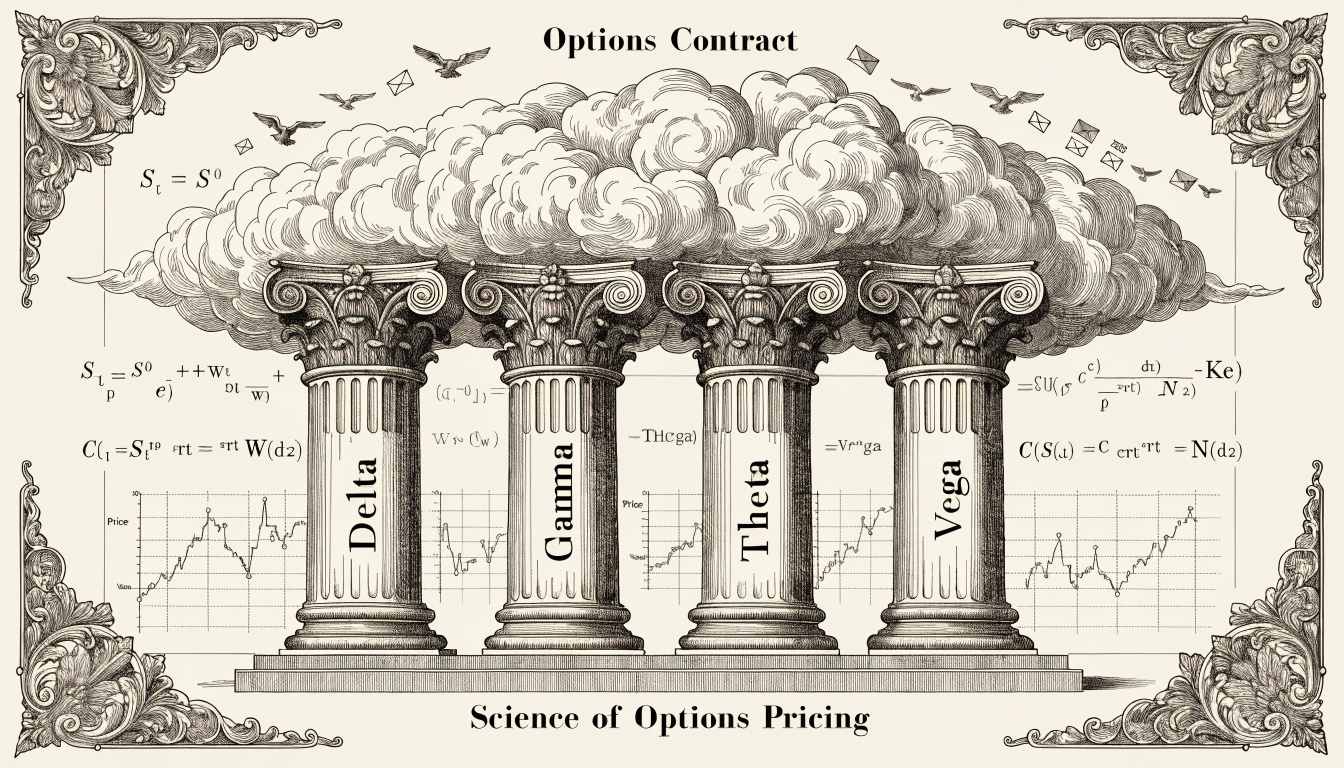
The Mechanics, with Numbers
Take a concrete instance. You hold 100 shares of AAPL at $190. You sell one 30-day call struck at $200 for a premium of $2.50, receiving $250 in cash credited at trade entry. Three things can happen at expiry.
If ST ≤ $200, the call expires worthless. You keep the shares and the $250. The position's P&L over the month is (ST − $190) × 100 + $250. Your effective entry on the long stock has been reduced from $190 to $187.50.
If ST > $200, the call is assigned. Your broker delivers the shares at $200 regardless of where the stock prints. P&L is fixed at ($200 − $190) × 100 + $250 = $1,250, and the upside above $200 belongs to the call buyer. The maximum payoff of the structure is K − S0 + C, capped, no matter how far ST exceeds K.
If ST drops sharply — say to $170 — the call expires worthless and you keep $250, but the stock leg has lost $2,000. The premium reduces a $2,000 loss to $1,750. That is the entire downside protection on offer. A covered call is not a hedge. For asymmetric downside protection, the structure you actually want is a protective put.
What You Are Actually Selling
The premium C decomposes, under Black-Scholes assumptions, into a function of S, K, T, σ, and r. Of those five inputs, the only one with meaningful operational variability across days for a given underlying is σ, the implied volatility. The premium you receive is, to first approximation, the market's expected magnitude of price movement over T, scaled by the moneyness of the strike.
This matters when deciding when to sell. Selling covered calls when implied volatility is at the 20th percentile of its own one-year distribution gives you a thin premium for the same upside cap as selling at the 80th percentile. The IV percentile of the underlying, not the headline VIX, is the conditioning variable. Two stocks at the same nominal IV of 25% can be in very different positions relative to their own term structures.
A defensible rule: condition entry on IV rank above the 50th percentile of the trailing 252 trading days for the specific name. Below that, the premium received is structurally low relative to what the long stock could deliver if it moves.
Strike Selection as a Trade-Off
The choice of K is the trade. It sets, simultaneously, the premium and the probability of assignment. Under a log-normal model, the probability of ST > K can be approximated by N(d2) for the call — close enough to the option's delta Δ that traders use Δ itself as the working estimate.
| Strike | Δ (approx P[assignment]) | Premium as % of S0 | Profile |
|---|---|---|---|
| Deep OTM (K ≈ 1.10 × S0) | 0.10–0.15 | 0.4–1.0% | Premium is small; the structure resembles long stock |
| Slightly OTM (K ≈ 1.03–1.05 × S0) | 0.20–0.35 | 1.5–3.0% | Most-cited choice; meaningful premium, room above |
| ATM (K ≈ S0) | 0.45–0.55 | 3.0–5.0% | Premium is maximal in absolute terms; upside is half-given-away in expectation |
| ITM (K < S0) | 0.70+ | varies, intrinsic + time | Effectively a planned exit at K |
The slightly-OTM choice is conventional because, for most underlyings under most regimes, Δ in the 0.25–0.30 range gives a premium that is meaningful relative to the underlying's recent realised volatility, while leaving the position with positive expected delta. The conventionality does not make it correct in every regime; it makes it a reasonable default.
Time Decay and Tenor
The short call's value decays at rate Θ, which under log-normal assumptions accelerates as expiry approaches. Empirically, more than half of an at-the-money option's extrinsic value decays in the final 30 days. This is the rationale for selling 30–45 days to expiry rather than longer-dated calls. As the seller, time decay runs in your favour by construction.
The trade-off is that shorter tenor means more frequent rebalancing, more frequent decisions about rolling, and more transaction-cost drag per unit of premium harvested. Modulo bid-ask spreads on the option chain, monthly cycles are typically the operational sweet spot for retail-scale positions. Weekly cycles capture more Θ per calendar day but multiply the cost frontier by a factor of four.
Assignment, Closing, and Rolling
If ST exceeds K at expiry, assignment occurs automatically through the broker. The shares leave the account and are replaced by cash at K × 100 per contract. There is no extra fee in most retail broker schedules, but the trade does generate a taxable event on the shares delivered.
Before expiry, three operational choices are available. Let the call run to expiry. Buy the call back to close the position — sensible if the call's market price has decayed substantially below the credit received and you wish to free the shares from the obligation. Or roll the call: simultaneously buy back the existing short call and sell a new one with a later expiry, possibly at a higher strike.
Rolling is not free. The combined trade prints either a small net credit or a small net debit, with the spread on both legs subtracted. It is most defensible when the original call has gone in the money and assignment is undesired for tax or position-management reasons. As a way to "save" a position that has run past its strike, rolling can extend the strategy indefinitely, but the structure is then mostly recovering the upside the original short call gave away. The mathematics are not generous about repeatedly trading away the right tail and expecting the position to compound.
When the Strategy Pays
The covered call's expected return profile, relative to long stock alone, is best in flat to mildly bullish regimes with high implied volatility. The intuition runs as follows. If realised volatility over T turns out to be lower than implied at trade entry, the short call decays faster than the long stock loses value to the cap, and the position outperforms. If realised exceeds implied and the move is upward, the cap is hit and the long-stock-only position outperforms by the difference between ST and K + C.
In photography terms, you are bracketing the exposure: instead of letting the long stock's full dynamic range come through, you are clipping the highlights at K in exchange for a known fill on the shadows. If the scene's highlights were going to clip on their own (sideways tape), the trade-off is favourable. If the scene's highlights contain the actual subject (a strong directional move up), you have lost the photograph.
This framing makes the strategy's failure mode legible. Covered calls underperform when implied volatility is low (premium is thin), the underlying rallies hard (cap binds and the rest of the upside is forfeit), or the underlying drops hard (premium provides only token cushion). They outperform in the dense middle of the return distribution — which, for many liquid US large-caps over sufficient horizons, is where most months actually land.
A Note from the Book I Run
I have run a monthly covered-call overlay on a long AAPL position for parts of the last two years. The conditions I imposed on entry: IV rank above 40, no entry within seven calendar days of an earnings release, Δ on the short call between 0.20 and 0.30, tenor 30–40 days. In aggregate, the overlay added roughly 0.7% per month to the long position in months where it was active, with two months where assignment cost a meaningful chunk of upside, and two months where the stock dropped sharply and the premium covered approximately 8% of the drawdown. The overlay did not change the position's left tail in any operationally important way. It changed the right tail's expected value by a known amount and the centre of the distribution by a smaller, positive one.
Practical Setup
For a retail-scale covered-call program, the setup that survives most stress tests has a few features in common. Position size in lots of 100 shares; positions in liquid names with tight option spreads (penny-wide on at least the front two monthlies); strikes selected by Δ rather than by absolute dollars above spot, so the position is consistent across underlyings of different price levels; entry conditioned on IV rank rather than calendar; explicit pre-rule about earnings (skip the cycle that contains the announcement, or sell a strike comfortably above the implied earnings move).
The premium is real income. The strategy has been documented by enough institutional desks for long enough that the structural edge, where one exists, is small and conditional on entry discipline. It is not a free yield. It is a known sale of upside in exchange for a known cash credit, and the question for any operator is whether the regime conditions support the trade in this particular cycle, not whether the strategy in general "works."
See also: Options Basics · What Are Dividends? · Position Sizing and Risk Management · Earnings Season · Bollinger Bands