Pittsburgh, then out
Druckenmiller grew up middle-class in Pittsburgh. His parents separated when he was young and he was raised largely by his father, a chemical engineer, which is the sort of biographical fact that tends to get over-interpreted in profiles of the successful. He read English and economics at Bowdoin College in Maine, started a PhD in economics at the University of Michigan, and abandoned it after one year to take an oil-analyst job at Pittsburgh National Bank. The academic reader may find the abandonment telling. The practitioner reads it as common sense: the opportunity cost of a thesis is rather high when markets are moving.
At PNC he moved quickly — head of equity research at 25, with a reputation for taking concentrated positions when he had conviction. In 1981, at 28, he founded Duquesne with a modest pool of capital. The firm would eventually manage over $12 billion. What is worth pausing on is not the growth of assets but the stability of the compounding; a great deal of Wall Street history consists of managers who posted spectacular numbers for five years and then gave most of it back. Druckenmiller did not.
The Soros years, 1988-2000
In 1988, Soros recruited Druckenmiller to run Quantum. The partnership worked because the two men supplied different things. Soros brought the philosophical scaffolding — reflexivity, the willingness to hold unfashionable views, the appetite for aggressive sizing — and Druckenmiller brought the analytical rigour and, crucially, the execution. A macro thesis is inert until someone puts on the trade at the right size at the right moment. That was Druckenmiller’s contribution.
He has described the effect Soros had on him in terms that are worth quoting directly: “Soros taught me that when you have tremendous conviction on a trade, you have to go for the jugular. It takes courage to be a pig.” Before Soros, he was a talented trader making sensibly-sized bets. After Soros, he was a talented trader concentrating capital into the ideas he was most confident about. The difference, on any honest accounting, is the difference between a successful career and an extraordinary one.
The sterling trade, September 1992
The episode that defined the partnership has been told so often it has become something of a parable. Britain was defending the pound inside the European Exchange Rate Mechanism, pegged against the German mark at a level that reflected the politics of the Major government rather than the economics of the Bundesbank. Britain was in recession and needed lower rates; Germany was managing the inflationary consequences of reunification and needed higher rates. A currency peg cannot reconcile two central banks pulling in opposite directions. That is not a subtle point.
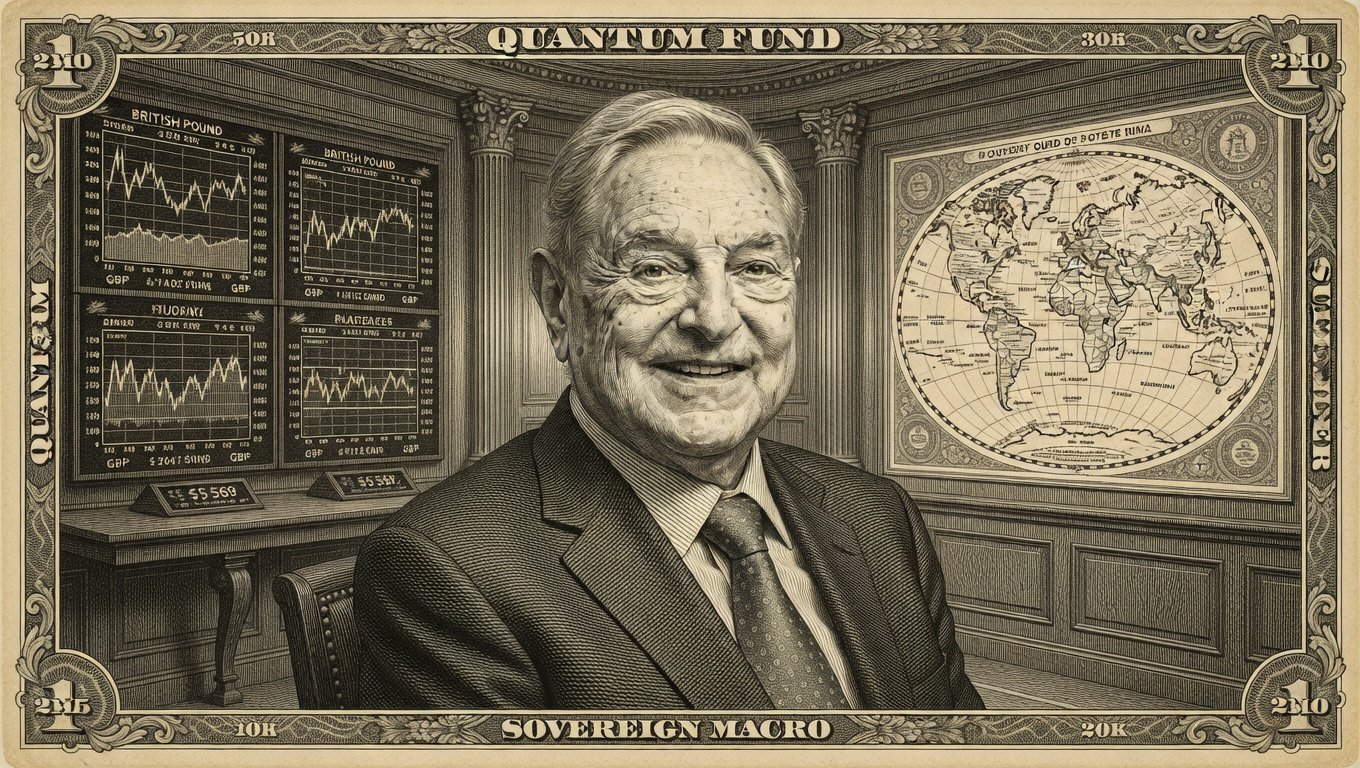
Druckenmiller identified the setup and recommended a large short on sterling. Soros, characteristically, pushed the size further. The fund ended up with roughly $10 billion against the pound — larger than Quantum’s capital, financed through leverage. On September 16, 1992, the Bank of England raised rates in the morning, raised them again in the afternoon, then gave up and left the ERM by evening. Sterling fell. Quantum made approximately $1 billion in a day.
Druckenmiller has been disarmingly plain about the trade: the analytical work was not the hard part. Any competent macro desk in London that summer could see the inconsistency. What was unusual was the willingness to put on the position at that size. “Bulls make money, bears make money, pigs get slaughtered — that’s what I heard when I got in the business,” he said. “I’m here to tell you I was a pig.” One hopes it does not require saying, but the injunction is addressed to professionals who have spent years calibrating conviction, not to readers who have spent years calibrating opinions.
The Druckenmiller method
Concentrate where the edge is real
The most distinctive feature of his approach is that diversification, in his view, is largely a confession that one does not know which of one’s ideas deserve conviction. When he has high conviction he concentrates — 30% or 50% of the book in a single position, sometimes more. This is the opposite of textbook position sizing and it would be ruinous advice for almost anyone reading this. The probability is non-trivial that it is ruinous advice for most professionals, too. It worked for Druckenmiller because he combined the concentration with the second thing, which matters more than the first.
Exit the moment the thesis breaks
A concentrated book is only viable if the book can be dismantled without sentiment. Druckenmiller’s record on loss-cutting is the reason the concentration did not periodically incinerate him. He exits when the reason for being in the trade has changed, not when the position has reached some prearranged stop, and not when he has finished rationalising why he was right all along. Like Paul Tudor Jones, he treats capital preservation as the prior condition to everything else; the great years come from the preservation during the difficult ones.
“It’s not whether you’re right or wrong that’s important,” he has said, echoing Soros, “but how much money you make when you’re right and how much you lose when you’re wrong.” The asymmetry is the entire business.
Top-down, instrument-agnostic
Druckenmiller works from the macro picture inward. He starts with central-bank policy, inflation dynamics, the yield curve, currency flows, the global cycle, and then looks for the cleanest instrument to express the view. Equities, bonds, FX, commodities — whichever offers the best risk-reward for the macro thesis he has formed. There is no loyalty to an asset class, which is easier to say than to practise; most managers marry the book they know and quietly ignore the one they do not.
The flexibility has a certain resemblance, if one will permit the comparison, to the way a serious buyer thinks about Burgundy vintages. A good merchant does not insist on a favourite village every year; he buys 2010 in one appellation and 2015 in another because the terroir and the weather co-operated differently, and he is indifferent to which label sits on the bottle as long as the wine in the glass justifies the price. Druckenmiller treats asset classes the way that merchant treats villages. The discipline is in being willing to move.
Liquidity is the variable
If there is a single line that summarises his framework, it is this: “Earnings don’t move the overall market; it’s the Federal Reserve Board — focus on the central banks and focus on the movement of liquidity.” The point is unglamorous and correct. Central-bank liquidity moves the discount rate applied to every other cash flow in the system. When the Fed expands its balance sheet or cuts rates, risk assets rise; when it contracts, they do not. This framework has been the north star throughout his career, and it is the single most portable piece of his method, which is perhaps why it is also the most often misapplied by retail readers who conflate “liquidity” with “prices must go up this quarter”.
The 2000 mistake
The most public failure of his career occurred during the dot-com bubble. In early 2000, Druckenmiller had correctly identified the bubble and sold his technology holdings. He then watched tech stocks continue to climb through February and March while his younger colleagues made money and he did not. He re-entered the long side near the peak. When the bubble gave way, Quantum lost around $3 billion in a matter of weeks.
His account of the episode is unusually honest: “I bought the top. It was a classic case of knowing what was right but being unable to do it because of the pain of watching everyone else make money.” There is something clarifying in that sentence. The greatest macro trader alive, in command of the correct analysis, failed the execution because human beings find relative under-performance intolerable in real time. Intellectual conviction and emotional conviction are not the same asset.
The lesson generalises uncomfortably. Anyone who has worked on a trading floor during a bubble has watched a version of this — experienced people, who had called the top correctly, being dragged back into the tape because the alternative was six months of explaining to a committee why their returns were flat. This is not a failure of analysis. It is a failure of incentives meeting psychology, and it is older than markets.
After Soros: Duquesne and the close
Druckenmiller left Quantum in 2000 and concentrated on Duquesne. The fund continued to deliver exceptional returns through the 2000s, including through the 2007-2008 dislocation, which he navigated substantially better than most of the industry. In 2010 he closed Duquesne to outside investors, citing the difficulty of maintaining his record while managing increasing sums — an explanation that was both true and, one suspects, incomplete. The psychological cost of continuing to post extraordinary numbers for an external client base, after three decades, is not a line item on a fee schedule, but it is real.
Since the closure he has managed his own fortune (widely estimated north of $6 billion) as a family office. His post-2010 track record is not publicly disclosed. What is visible through occasional interviews and SEC filings is that he remains active, concentrated, and unsentimental about asset classes, which was always the thing.
Druckenmiller on paper
- “Put all your eggs in one basket — and watch that basket very carefully.” Concentration is the edge; vigilance is the discipline that prevents concentration from becoming a confession of recklessness.
- “The way to build long-term returns is through preservation of capital and home runs.” Compound conservatively in ordinary periods, size aggressively when the macro setup is genuinely rare. The two behaviours are not contradictions; they are complements.
- “Never, ever invest in the present. Discount the future.” Current earnings are already in the price. What matters is the change in the expected path — which is why macro variables, liquidity in particular, dominate.
- “I learned you could be right on a market and still end up losing if you use too much leverage.” Correct analysis is the necessary condition; correct sizing is the sufficient one. The 1994 bond trade, where he was directionally right about Fed tightening but sized incorrectly, is the example he uses.
Philanthropy, fiscal warnings
Druckenmiller has given hundreds of millions of dollars to education, medical research, and anti-poverty work, concentrated in New York City and Pittsburgh. The giving mirrors the investing — large concentrated bets on initiatives he has researched, rather than a broad spread of smaller cheques. He has funded early-childhood programmes, the Harlem Children’s Zone, and medical research at NYU, among others.
He has also been sharper than most of his peers on what he considers the central fiscal problem of the United States: the intergenerational transfer implicit in current spending patterns, funded by debt issued to future cohorts. He has argued this in interviews for years, long before the debt-to-GDP number crossed the thresholds that made it fashionable to worry about. Martin Wolf in the FT has made a related argument from a different angle. The probability that both men are wrong on the same question is, one imagines, low; the probability that the system adjusts in an orderly manner remains the base case, because systems usually do. Tail risk, as ever, lies elsewhere.
Here is a point on which hedging will not help. Running fiscal deficits of this magnitude, at this point in the cycle, with interest expense already exceeding defence spending, is a policy error. It is not a matter of probability. It is a matter of arithmetic deferred.
What is actually portable
Druckenmiller’s career is the most compelling single piece of evidence that skill, not luck, can drive sustained outperformance in markets — thirty years, no losing calendar year, across multiple regimes. But the question that matters for readers is not whether he has skill; it is which parts of his method transfer and which do not.
The concentration does not transfer. Almost nobody reading this has the process, the information flow, or the emotional constitution to put 30% of a portfolio in a single trade and sleep. Attempting to imitate it on retail terms is a route to ruin. The ruthless exit discipline does transfer, at least in principle, though in practice it requires a level of self-honesty that most of us discover we lack at the moment we most need it. The instrument-agnostic, top-down framing — starting from central banks and liquidity, then choosing the cleanest expression — transfers usefully, and it is the part worth studying.
The most transferable lesson is the one Druckenmiller states most plainly: doing nothing is a position. Sitting in cash when there is no edge, refusing to trade merely because the market is open, is an underpriced skill. Most traders lose money in the flat periods between the good setups, not at the setups themselves. The discipline to wait is the discipline the record is built on. The rest is detail. Time will tell, which is what every writer on markets is eventually obliged to say, but in this particular case the tell has already happened; the track record is closed and the number is what it is.
See also: George Soros · Paul Tudor Jones · The Dot-Com Bubble · Position Sizing and Risk Management · Trading Psychology: Fear and Greed